
I’ve come up with a term to illustrate something I’ve been thinking about lately. Cognitive paywalling: the process by which deeper insight, nuanced context or critical thinking becomes accessible only through paid tiers of AI platforms.
When streaming first reshaped how we consume TV, movies, news and music, it felt radically open. But once we became hooked, the basic free versions or cheaper subscriptions became increasingly limited. And soon much of the content and features we had become accustomed to were behind another payment, another tier, another upgrade.
I can’t help but feel that AI is on that same course, but on a hugely accelerated trajectory.
In a remarkably short space of time, we’ve gone from experimenting with tools like ChatGPT to relying on them. We’re beginning to use them across more and more aspects of our lives: making decisions, filling gaps in expertise, legal and medical advice, even therapy and companionship. ChatGPT, particularly, has changed from just being a tool to something we rely on instinctively within the space of one year.
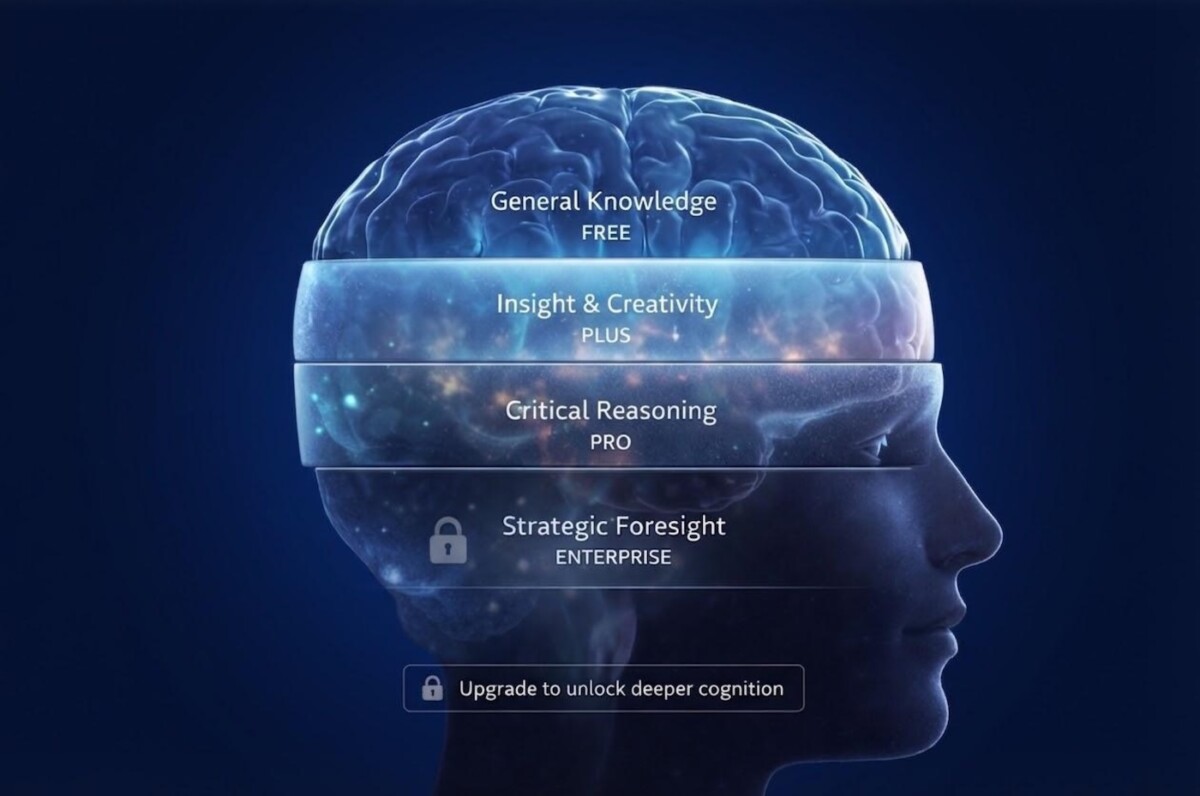
Streaming has taught us that ownership is clutter. Are we in the process of decluttering our brains? If our ability to think critically is outsourced, streamed to us by an AI which could change its content and access at a moment’s notice and we become entirely dependent on it… What happens when everything we thought we knew disappears behind a paywall?
Perhaps the free layer won’t vanish, but answers may lack depth, context or sources. The most valuable intelligence sitting behind higher tiers. Over time, that divide could widen economic, knowledge and health gaps, leading to better outcomes for those with access.
In The Time Machine, H.G. Wells imagined a future where humanity had split into two groups: one living comfortably above ground, the other labouring beneath it. A society separated by a slow structural drift.
If AI is becoming something closer to infrastructure than a product, then it may be time to consider the same kind of guardrails we once argued for with the internet, before a divergence becomes something more permanent.
Enjoyed this perspective? We love to talk about how we can all design better tech-enabled experiences using a human lens.