
What do Anthropic customers, the game studio MegaCrit, and the French government all have in common? They all experienced a break in their trust with their SaaS licenses. But why?
In April, Anthropic quietly tested a new pricing model for the Pro Plan, removing their popular agentic development tool. Users were upset, demanding transparency and better communication from Anthropic. Explanations were offered, the new pricing model was abandoned, but the damage was done.
This is a trend happening across all industries. In 2023, popular indie games studio Megacrit (developers of Slay the Spire 1 & II) cancelled their licence with Unity after the game engine announced that they would charge developers with runtime fees, switching to Godot instead, an open-source platform. The French government is currently in the process of swapping their expensive Microsoft licenses for open-source Linux. These are clear indicators of a broader shift: customers are no longer locked in by inertia. When value slips, they actively exit.
Customers are no longer locked in by inertia. When value slips, they actively exit.
SaaS has quietly broken traditional brand loyalty. Cultivating loyalty with customers is now, more than ever, crucial to a successful product. With Software as a Service (Saas) coming as standard with physical and digital products, consumers are having to make purchasing decisions with long term implications to their budget and ecosystem. How much is this going to cost me in the longterm, and does it fit with the way I want to live? For the longest time, quality of a product relied heavily on not just quality, but also longevity: how long is this going to work for before it breaks and I have to buy a new one? In a world where SaaS is the dominant product, quality and longevity takes on a whole new meaning. How long will I receive support, what exciting innovations are coming, and when does the cost outweigh the value provided? In a subscription economy, loyalty is reset and reevaluated with every billing cycle.
In a subscription economy, loyalty is reset and reevaluated with every billing cycle.
Enter the Loyalty Threshold, a calculation that consumers are making on a daily basis whenever they are interacting with your service. The loyalty threshold is the point at which accumulated friction outweighs perceived value. While cost plays a key role, consumers are also taking note of how their business is being valued. The strength of SaaS vs. analogue products is that companies can demonstrate their dedication to consumers by continuing to increase the value they provide. However, slippage can cause major rifts in this exchange, leading customers to take their business elsewhere.
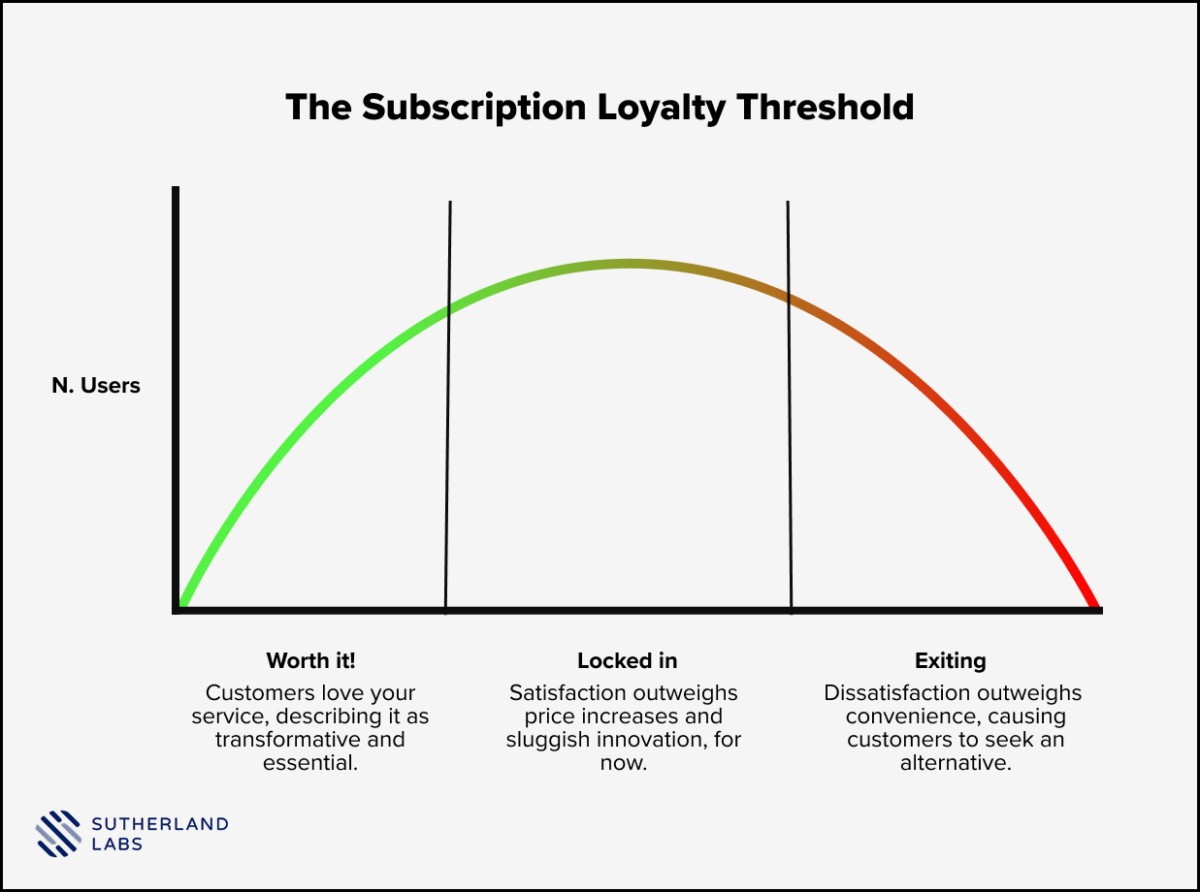
Strong brand loyalty shouldn’t be taken for granted and attrition isn’t random. Sudden changes in pricing structure, terms of service, and value provided all contribute to the loyalty threshold. Household brands can’t rest on their laurels expecting consumers to behave the same no matter what.
The loyalty threshold is the point at which accumulated friction outweighs perceived value.
How much longer do you expect your brand to grow without evidence-based decision making shaping the future of your service? You may have metrics such as churn, but they don’t tell you why it’s happening. This is where strategic research plays a critical role. If you don’t know how your customers are reacting to changes to your models, what alternatives they’re considering, and what customer loyalty means in today’s market, you’re going to fall behind.
Enjoyed this perspective? We love to talk about how we can all design better tech-enabled experiences using a human lens.